
Passer aux informations produits
1 de 1
Œuvre en exclusivité dans notre galerie d'art !

T’ETENDRE

T’ETENDRE

États-Unis d’Amériques

JChadima

Peinture

Style : Abstrait

Huile, Toile de lin, 2025

92 cm x 65 cm

Prix habituel €6.450,00 EUR
Prix habituel Prix promotionnel €6.450,00 EUR
Promotion Vendue
Taxes incluses. Frais d'expédition calculés à l'étape de paiement.

Envois & Retours

  • Livraison professionnelle dans le monde entier, contrôlée par nos experts logistiques
  • Les frais d'expédition, taxes et frais de douane sont inclus dans le prix

Garantie

Horizon World Art garantit fiabilité et traçabilité.

Tous les artistes de la plateforme ont été spécialement sélectionnés et certifient ne vendre que des œuvres dont ils sont les auteurs. Quel que soit le support, l'œuvre est envoyée à l'acheteur avec un certificat d'authenticité. Les photographies sont numérotées et signées.

Chaque client peut recevoir une copie de son certificat d'authenticité en contactant contact@horizonworldart.com

Paiement

Avec Horizon World Art, vous pouvez payer en toute sécurité par carte bancaire ou virement bancaire.

Pour toutes transactions dépassant votre limite de crédit, contactez-nous. Nous sommes tenus de vérifier chaque transfert, dans le cadre de la lutte contre la fraude et le blanchiment d'argent.

Prix

Les prix Horizon World Art incluent ce qui suit :

  • Prix d'une œuvre défini par un artiste
  • Assurance. Votre commande est protégée à 100% en cas de dommages ou de perte
  • Préparation des frais de douane, des taxes et des documents
  • Frais d'expédition du prestataire logistique
  • Un spécialiste du service client Horizon World Art qui répondra à toutes vos questions ou préoccupations lors de l'expédition
Œuvre unique signée Avec certificat d'authenticité
Livraison A l'international par des spécialistes
Paiement sécurisé Carte bancaire avec cryptage SSL
Afficher tous les détails

A propos de l'oeuvre

T’ETENDRE

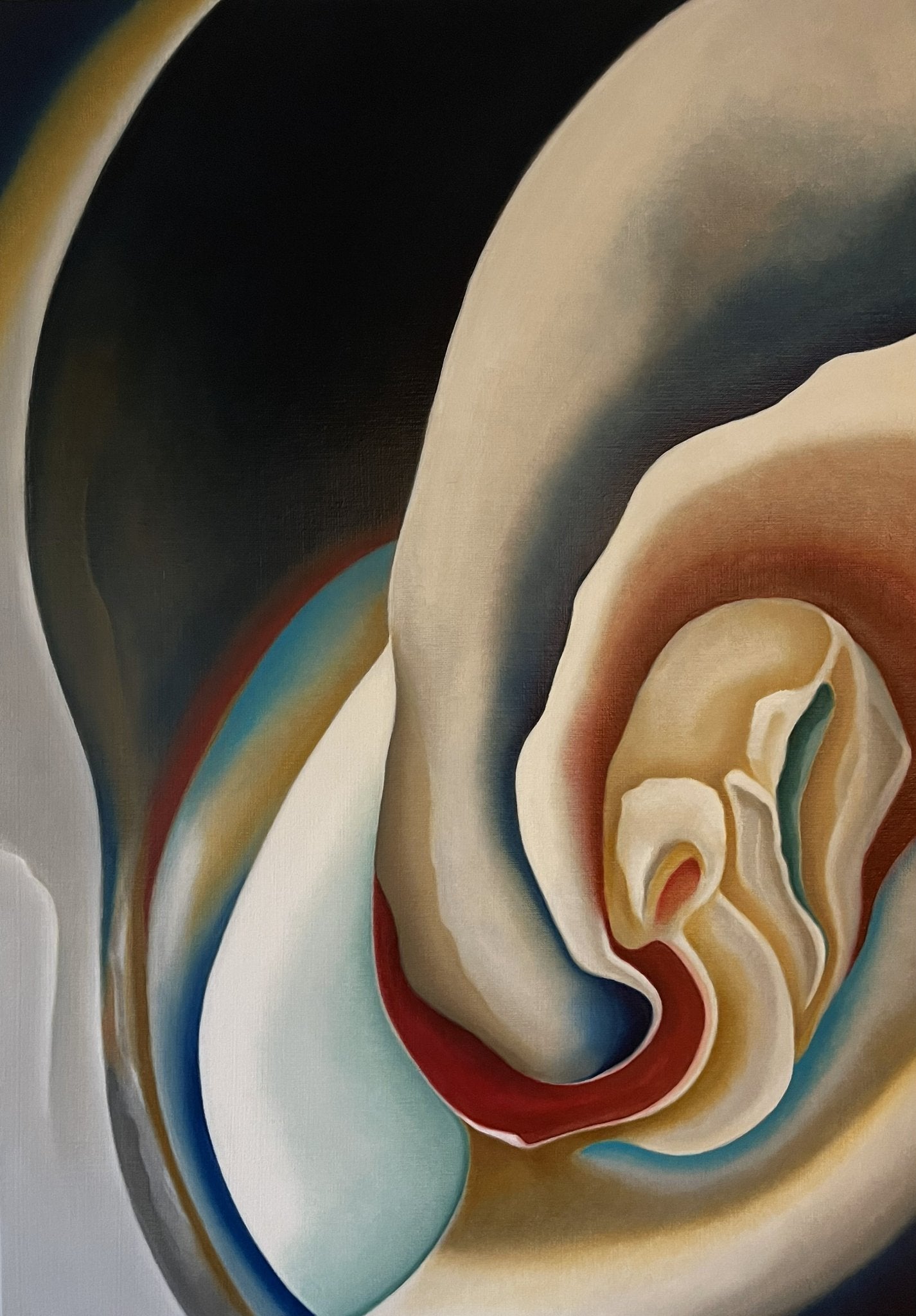
T’entendre is the first of two paintings and the larger, establishing the visual and conceptual foundation for the work that followed. Its title, translated from the French as “to hear you,” introduces a deeply personal dimension to a composition that moves fluidly between the recognizable and the abstract.

The inspiration for T’entendre originated during an evening conversation in a favourite Parisian café, where JChadima was surrounded by friends speaking several languages simultaneously. As different languages and conversations overlapped, the artist became acutely aware of the sensation of the ear being filled with sound—and of the challenge of separating, interpreting, and understanding what was being heard. That experience became the conceptual foundation for the painting, transforming the physical act of hearing into a meditation on language, communication, and human connection.

The painting takes the organic structure of the human ear as its point of departure, dramatically enlarging and transforming it into a landscape of sweeping curves, enclosed spaces, and rhythmic passages of colour. At this larger scale, the familiar anatomy becomes something more universal. The ear is no longer simply an observed object; it becomes an environment—an exploration of listening, intimacy, communication, and understanding.

JChadima builds the composition through sensuous, continuous forms that curl inward and unfold outward. Creams, ochres, deep reds, turquoise blues, and near-black passages move against one another with a carefully controlled intensity. Soft transitions of light and shadow give the forms volume, while bold arcs and concentrated areas of colour create an intense sense of movement. The eye is continually drawn inward toward the intricate central forms before being carried outward again along the larger sweeping contours.

There is an intriguing duality within T’entendre. The forms can suggest anatomy, landscape, shells, petals, or other organic structures, yet they resist settling into any single interpretation. This ambiguity allows the painting to operate simultaneously as an intimate study of the body and as an abstract composition of shape, colour, movement, and negative space.

As the first of the two paintings, T’entendre establishes an important theme that JChadima would continue to explore in the smaller T’entendre 2: the transformation of an easily overlooked part of the human form into something monumental and contemplative. The larger scale of this first painting intensifies that experience, inviting the viewer not merely to look at the subject but to enter it visually.

Ultimately, T’entendre is about more than the physical act of hearing. Born from an evening of overlapping voices and languages in Paris, it suggests the more profound act of listening—the desire to understand another person even when words, languages, and sounds compete for our attention.

Provenance:

AKOUN CERTIFIED: 6450 Euros
À propos de l’œuvre

T’ETENDRE

T’entendre is the first of two paintings and the larger, establishing the visual and conceptual foundation for the work that followed. Its title, translated from the French as “to hear you,” introduces a deeply personal dimension to a composition that moves fluidly between the recognizable and the abstract.

The inspiration for T’entendre originated during an evening conversation in a favourite Parisian café, where JChadima was surrounded by friends speaking several languages simultaneously. As different languages and conversations overlapped, the artist became acutely aware of the sensation of the ear being filled with sound—and of the challenge of separating, interpreting, and understanding what was being heard. That experience became the conceptual foundation for the painting, transforming the physical act of hearing into a meditation on language, communication, and human connection.

The painting takes the organic structure of the human ear as its point of departure, dramatically enlarging and transforming it into a landscape of sweeping curves, enclosed spaces, and rhythmic passages of colour. At this larger scale, the familiar anatomy becomes something more universal. The ear is no longer simply an observed object; it becomes an environment—an exploration of listening, intimacy, communication, and understanding.

JChadima builds the composition through sensuous, continuous forms that curl inward and unfold outward. Creams, ochres, deep reds, turquoise blues, and near-black passages move against one another with a carefully controlled intensity. Soft transitions of light and shadow give the forms volume, while bold arcs and concentrated areas of colour create an intense sense of movement. The eye is continually drawn inward toward the intricate central forms before being carried outward again along the larger sweeping contours.

There is an intriguing duality within T’entendre. The forms can suggest anatomy, landscape, shells, petals, or other organic structures, yet they resist settling into any single interpretation. This ambiguity allows the painting to operate simultaneously as an intimate study of the body and as an abstract composition of shape, colour, movement, and negative space.

As the first of the two paintings, T’entendre establishes an important theme that JChadima would continue to explore in the smaller T’entendre 2: the transformation of an easily overlooked part of the human form into something monumental and contemplative. The larger scale of this first painting intensifies that experience, inviting the viewer not merely to look at the subject but to enter it visually.

Ultimately, T’entendre is about more than the physical act of hearing. Born from an evening of overlapping voices and languages in Paris, it suggests the more profound act of listening—the desire to understand another person even when words, languages, and sounds compete for our attention.

Provenance:

AKOUN CERTIFIED: 6450 Euros

fallback text for a video
A propos de l'artiste Jchadima

JChadima (James Chadima) is a Paris-based multidisciplinary artist whose work has been exhibited and collected internationally.

Born in Wisconsin, United States, JChadima studied at the University of Southern Colorado (USC), now Colorado State University Pueblo, where he earned several degrees. He began exhibiting and selling his work at an early age, establishing the foundations of a multidisciplinary practice in which drawing, painting, and photography would become closely intertwined.

His artistic formation was shaped by an important pedagogical lineage extending into twentieth-century American Modernism and fine-art photography. Particularly influential were his studies with Professor John Henry Johnson, whose guidance helped JChadima cultivate a more discerning way of seeing—one that looked beyond the immediate subject to recognize the expressive potential of light, form, structure, and details that might otherwise escape notice. Johnson’s personal relationships and correspondence with Ansel Adams and others associated with the American Modernist movement provided JChadima with an important connection to an earlier generation. This formative experience situated his developing vision within a broader dialogue with American Modernist figures such as Alfred Stieglitz, Georgia O’Keeffe, Arthur Dove, and Adams, whose work demonstrated how close observation and individual perception could transform familiar subjects into powerful vehicles for abstraction and expression.

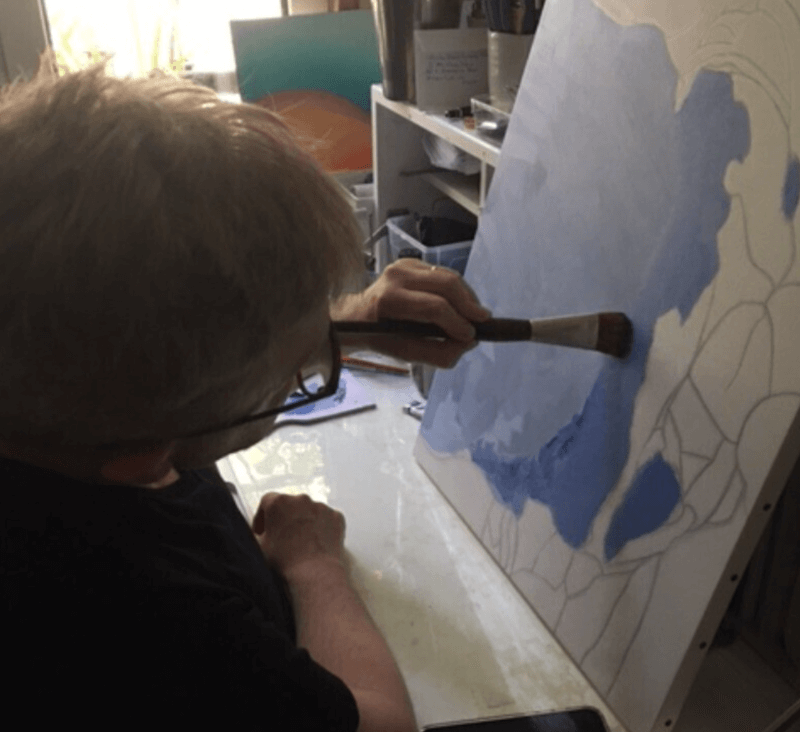
Photography is both the initial stage and an integral component of JChadima’s creative process, functioning as an independent medium as well as a means of visual discovery. His subjects are drawn from nature, still life, urban and environmental surroundings, and the broader cultural landscape of contemporary life. Through the camera, he isolates relationships of light, line, form, colour, pattern, and texture, revealing visual structures that can easily pass unnoticed. These photographic impressions often provide the initial impetus for his paintings, in which recognizable imagery is distilled, reorganized, and transformed through abstraction. The resulting compositions are highly stylized and graphic, distinguished by structural clarity, rhythmic relationships, and a vibrant use of colour.

Central to JChadima’s philosophy is a belief in a “hidden magic” within our surroundings and ourselves. His focus on modest, familiar, and frequently overlooked subjects reflects a desire to recover a sense of wonder increasingly obscured by the visual noise, accelerated pace, and environmental pressures of contemporary life.
The ordinary is not simply recorded; it becomes material for reconsideration and transformation.

A tree, leaf, flower, architectural detail, or fragment of landscape becomes more than a recognizable subject. Through isolation and abstraction, a single detail can reshape our perception of the whole, while forms drawn from nature evoke both their inherent beauty and fragility in the face of growing environmental pressures.

Ultimately, JChadima’s art invites us to pause and look again, revealing the extraordinary within the seemingly ordinary while renewing our awareness of nature and our relationship with it.

Recognized by AKOUN, an international art-market reference, JChadima holds an established international quotation for his work.

RECENT PUBLICATIONS:
https://louvreunbound.aflip.in/2a9d2d8df5.html#page/38