

SHAMAN
SHAMAN
États-Unis d’Amériques
JChadimaPeinture
Style : Abstrait
Huile, Toile de lin, 2022
41 cm x 33 cm
Impossible de charger la disponibilité du service de retrait
Envois & Retours
Envois & Retours
- Livraison professionnelle dans le monde entier, contrôlée par nos experts logistiques
- Les frais d'expédition, taxes et frais de douane sont inclus dans le prix
Garantie
Garantie
Horizon World Art garantit fiabilité et traçabilité.
Tous les artistes de la plateforme ont été spécialement sélectionnés et certifient ne vendre que des œuvres dont ils sont les auteurs. Quel que soit le support, l'œuvre est envoyée à l'acheteur avec un certificat d'authenticité. Les photographies sont numérotées et signées.
Chaque client peut recevoir une copie de son certificat d'authenticité en contactant contact@horizonworldart.com
Paiement
Paiement
Avec Horizon World Art, vous pouvez payer en toute sécurité par carte bancaire ou virement bancaire.
Pour toutes transactions dépassant votre limite de crédit, contactez-nous. Nous sommes tenus de vérifier chaque transfert, dans le cadre de la lutte contre la fraude et le blanchiment d'argent.
Prix
Prix
Les prix Horizon World Art incluent ce qui suit :
- Prix d'une œuvre défini par un artiste
- Assurance. Votre commande est protégée à 100% en cas de dommages ou de perte
- Préparation des frais de douane, des taxes et des documents
- Frais d'expédition du prestataire logistique
- Un spécialiste du service client Horizon World Art qui répondra à toutes vos questions ou préoccupations lors de l'expédition
A propos de l'oeuvre
À propos de l’œuvre
SHAMAN
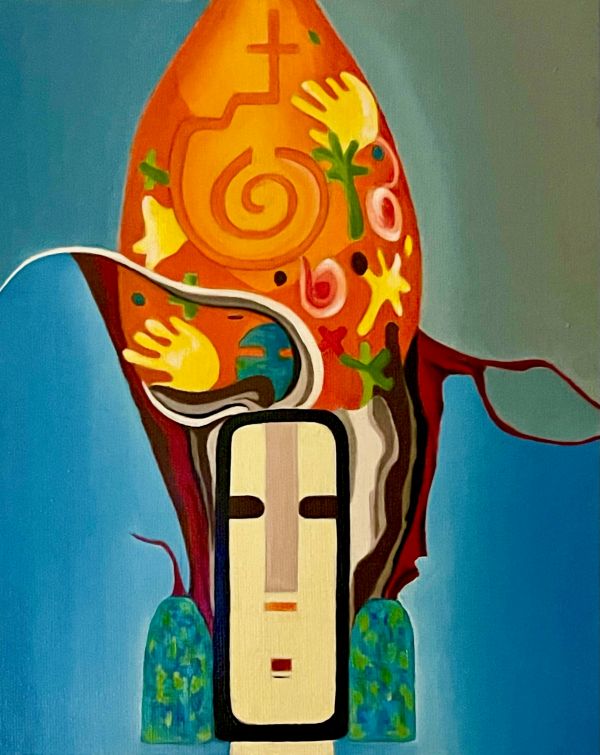
Shaman explores the figure of the spiritual intermediary—a presence found in many cultures throughout the world and reflected in the traditions of Native American medicine people, healers, and spiritual leaders. Rather than representing a specific individual or tribal tradition, JChadima creates an imagined figure that draws upon the universal relationship between humanity, nature, healing, and the spiritual world.
The elongated face is deliberately restrained and mask-like, giving the figure a quiet, contemplative presence. Its rectangular form also carries an unmistakably contemporary reference: the shape of a modern handheld communication device. This subtle visual connection introduces a compelling contrast between ancient and modern forms of communication—one seeking connection with the spiritual and natural worlds, the other connecting people through technology.
Above the face rises an elaborate headdress-like form filled with hands, spirals, crosses, plant forms, geometric markings, and organic symbols. These elements suggest a visual vocabulary of ritual, nature, human experience, and spiritual awareness without assigning them to a single cultural tradition.
The spiral provides a strong focal point within the composition, suggesting cycles, movement, transformation, and continuity. Open hands can be read as gestures of healing, protection, offering, or communication, while the plant-like forms reinforce the shaman’s traditional connection to the natural world and its restorative powers.
JChadima uses a vivid palette of turquoise blue, burnt orange, yellow, green, deep red, earth brown, near black, and ivory. The turquoise and earthen tones evoke the landscape and visual character of the American Southwest, while the brilliant orange field gives the upper portion of the figure an almost radiant energy.
The painting also acknowledges that the idea of a spiritual healer is not unique to one people or place. Across many cultures, individuals have served as mediators between the physical and spiritual worlds, drawing upon ceremony, nature, inherited knowledge, and community traditions. In the Native American context, the more culturally appropriate terms are often medicine person, healer, or spiritual leader, depending upon a nation in particular or tradition.
In Shaman, JChadima brings these ideas together through a distinctly contemporary language of abstraction. Ancient symbolism and modern communication meet within a single figure, creating a meditation on healing, intuition, transformation, and humanity’s enduring desire to connect—both with one another and with forces beyond the visible world.
Provenance:
AKOUN CERTIFIED: 1175 Euros
Jchadima
-
DEVIL'S SNARE 1
Artiste :JchadimaPrix habituel €625,00 EURPrix habituelPrix unitaire par -
DEVIL'S SNARE 2
Artiste :JchadimaPrix habituel €625,00 EURPrix habituelPrix unitaire par -
CLEMENTINE STUDY (Etude aux clémentines)
Artiste :JchadimaPrix habituel €850,00 EURPrix habituelPrix unitaire par


