
Passer aux informations produits
1 de 1
Œuvre en exclusivité dans notre galerie d'art !

SPRINTIME IN PARIS 5

SPRINTIME IN PARIS 5

États-Unis d’Amériques

JChadima

Peinture

Style : Abstrait

Huile, Toile de lin,

55 cm x 46 cm

Prix habituel €2.175,00 EUR
Prix habituel Prix promotionnel €2.175,00 EUR
Promotion Épuisé
Taxes incluses. Frais d'expédition calculés à l'étape de paiement.

Envois & Retours

  • Livraison professionnelle dans le monde entier, contrôlée par nos experts logistiques
  • Les frais d'expédition, taxes et frais de douane sont inclus dans le prix

Garantie

Horizon World Art garantit fiabilité et traçabilité.

Tous les artistes de la plateforme ont été spécialement sélectionnés et certifient ne vendre que des œuvres dont ils sont les auteurs. Quel que soit le support, l'œuvre est envoyée à l'acheteur avec un certificat d'authenticité. Les photographies sont numérotées et signées.

Chaque client peut recevoir une copie de son certificat d'authenticité en contactant contact@horizonworldart.com

Paiement

Avec Horizon World Art, vous pouvez payer en toute sécurité par carte bancaire ou virement bancaire.

Pour toutes transactions dépassant votre limite de crédit, contactez-nous. Nous sommes tenus de vérifier chaque transfert, dans le cadre de la lutte contre la fraude et le blanchiment d'argent.

Prix

Les prix Horizon World Art incluent ce qui suit :

  • Prix d'une œuvre défini par un artiste
  • Assurance. Votre commande est protégée à 100% en cas de dommages ou de perte
  • Préparation des frais de douane, des taxes et des documents
  • Frais d'expédition du prestataire logistique
  • Un spécialiste du service client Horizon World Art qui répondra à toutes vos questions ou préoccupations lors de l'expédition
Œuvre unique signée Avec certificat d'authenticité
Livraison A l'international par des spécialistes
Paiement sécurisé Carte bancaire avec cryptage SSL
Afficher tous les détails

A propos de l'oeuvre

SPRINTIME IN PARIS 5

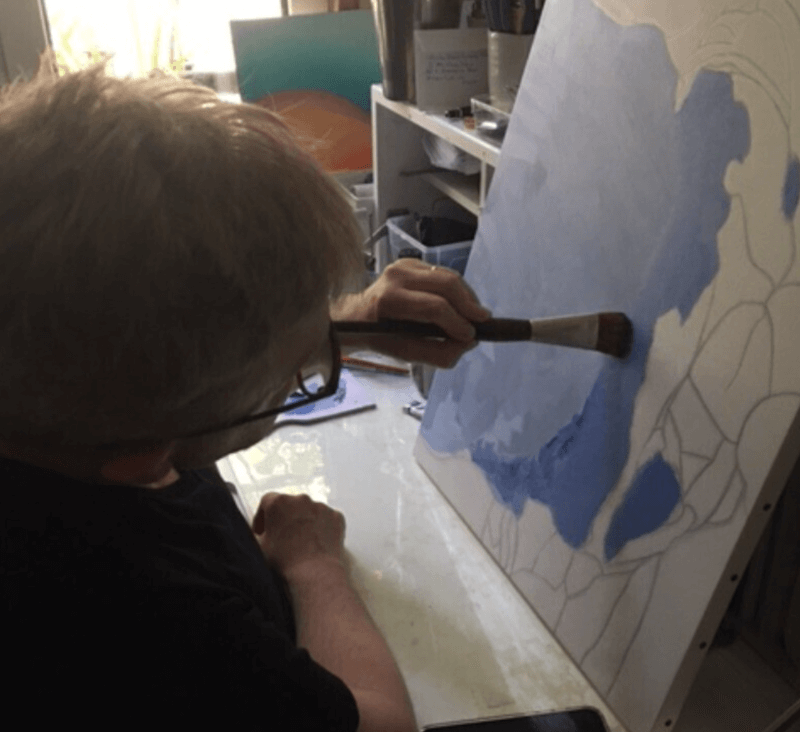
Springtime in Paris 5 is one of the most restrained and atmospheric paintings in this body of work. Painted in 2024, it originated from a photograph taken from within a plant at the Jardin des Plantes in Paris’s 5th arrondissement. On an unusually hazy Parisian day, dense cloud cover softened and diffused the available light, transforming the plant’s interior into something quiet, pale, and almost immaterial.

Rather than reproducing the photograph literally, the painting seeks to preserve the impression and sensation of that particular light. Forms emerge through extremely subtle shifts of white, grey, cream, and the faintest suggestions of cool blue and lavender. What initially appears to be an almost monochromatic field gradually reveals an intricate botanical structure. Leaves and interior forms seem to materialize from the surrounding atmosphere before quietly dissolving back into it.

This ethereal quality distinguishes No. 5 from many of the more chromatically assertive works in the collection. Where other paintings employ stronger contrasts, saturated colour, and more clearly defined organic forms, this composition depends upon restraint, translucency, diffused light, and exceptionally delicate tonal relationships. The subject is present but does not immediately announce itself. Instead, the viewer is invited to search for it, allowing the imagery to reveal itself gradually as the eye adjusts to subtle variations across the surface.

The work shares an affinity with Agnes Martin, particularly in its quietness, restraint, and attention to nearly imperceptible detail. The connection is less one of direct visual resemblance than of a shared belief in sustained looking. Like Martin’s paintings, No. 5 rewards patience, and stillness. Details that might initially go unnoticed become increasingly present when the viewer gives the image time to unfold.

Within the larger group of Paris-inspired botanical paintings, No. 5 represents an especially contemplative exploration of the artist’s interest in looking beyond what is immediately visible. Here, representation approaches abstraction not through dramatic simplification or intense colour, but through the opposite means: reduced contrast, softened boundaries, subtle tonal variation, and light itself.

Ultimately, the painting is about slowing down enough to see. What first appears nearly empty gradually becomes complex; what seems monochromatic begins to reveal colour; and what might ordinarily be overlooked becomes worthy of prolonged attention. A fleeting encounter on a hazy day in Paris is transformed into an intimate meditation on perception, stillness, and the quiet beauty hidden within the living forms that surround us.


Provenance :

CERTIFIED EXPERT N° 20260903095634 | REFERENCE/ISNI : 2024-22

AKOURN CERTIFIED : 2175 Euros.
Exhibitions :

2024 CARROUSEL DU LOUVRE, PARIS
 

À propos de l’œuvre

SPRINTIME IN PARIS 5

Springtime in Paris 5 is one of the most restrained and atmospheric paintings in this body of work. Painted in 2024, it originated from a photograph taken from within a plant at the Jardin des Plantes in Paris’s 5th arrondissement. On an unusually hazy Parisian day, dense cloud cover softened and diffused the available light, transforming the plant’s interior into something quiet, pale, and almost immaterial.

Rather than reproducing the photograph literally, the painting seeks to preserve the impression and sensation of that particular light. Forms emerge through extremely subtle shifts of white, grey, cream, and the faintest suggestions of cool blue and lavender. What initially appears to be an almost monochromatic field gradually reveals an intricate botanical structure. Leaves and interior forms seem to materialize from the surrounding atmosphere before quietly dissolving back into it.

This ethereal quality distinguishes No. 5 from many of the more chromatically assertive works in the collection. Where other paintings employ stronger contrasts, saturated colour, and more clearly defined organic forms, this composition depends upon restraint, translucency, diffused light, and exceptionally delicate tonal relationships. The subject is present but does not immediately announce itself. Instead, the viewer is invited to search for it, allowing the imagery to reveal itself gradually as the eye adjusts to subtle variations across the surface.

The work shares an affinity with Agnes Martin, particularly in its quietness, restraint, and attention to nearly imperceptible detail. The connection is less one of direct visual resemblance than of a shared belief in sustained looking. Like Martin’s paintings, No. 5 rewards patience, and stillness. Details that might initially go unnoticed become increasingly present when the viewer gives the image time to unfold.

Within the larger group of Paris-inspired botanical paintings, No. 5 represents an especially contemplative exploration of the artist’s interest in looking beyond what is immediately visible. Here, representation approaches abstraction not through dramatic simplification or intense colour, but through the opposite means: reduced contrast, softened boundaries, subtle tonal variation, and light itself.

Ultimately, the painting is about slowing down enough to see. What first appears nearly empty gradually becomes complex; what seems monochromatic begins to reveal colour; and what might ordinarily be overlooked becomes worthy of prolonged attention. A fleeting encounter on a hazy day in Paris is transformed into an intimate meditation on perception, stillness, and the quiet beauty hidden within the living forms that surround us.


Provenance :

CERTIFIED EXPERT N° 20260903095634 | REFERENCE/ISNI : 2024-22

AKOURN CERTIFIED : 2175 Euros.
Exhibitions :

2024 CARROUSEL DU LOUVRE, PARIS


fallback text for a video
A propos de l'artiste Jchadima

JChadima (James Chadima) is a Paris-based multidisciplinary artist whose work has been exhibited and collected internationally.

Born in Wisconsin, United States, JChadima studied at the University of Southern Colorado (USC), now Colorado State University Pueblo, where he earned several degrees. He began exhibiting and selling his work at an early age, establishing the foundations of a multidisciplinary practice in which drawing, painting, and photography would become closely intertwined.

His artistic formation was shaped by an important pedagogical lineage extending into twentieth-century American Modernism and fine-art photography. Particularly influential were his studies with Professor John Henry Johnson, whose guidance helped JChadima cultivate a more discerning way of seeing—one that looked beyond the immediate subject to recognize the expressive potential of light, form, structure, and details that might otherwise escape notice. Johnson’s personal relationships and correspondence with Ansel Adams and others associated with the American Modernist movement provided JChadima with an important connection to an earlier generation. This formative experience situated his developing vision within a broader dialogue with American Modernist figures such as Alfred Stieglitz, Georgia O’Keeffe, Arthur Dove, and Adams, whose work demonstrated how close observation and individual perception could transform familiar subjects into powerful vehicles for abstraction and expression.

Photography is both the initial stage and an integral component of JChadima’s creative process, functioning as an independent medium as well as a means of visual discovery. His subjects are drawn from nature, still life, urban and environmental surroundings, and the broader cultural landscape of contemporary life. Through the camera, he isolates relationships of light, line, form, colour, pattern, and texture, revealing visual structures that can easily pass unnoticed. These photographic impressions often provide the initial impetus for his paintings, in which recognizable imagery is distilled, reorganized, and transformed through abstraction. The resulting compositions are highly stylized and graphic, distinguished by structural clarity, rhythmic relationships, and a vibrant use of colour.

Central to JChadima’s philosophy is a belief in a “hidden magic” within our surroundings and ourselves. His focus on modest, familiar, and frequently overlooked subjects reflects a desire to recover a sense of wonder increasingly obscured by the visual noise, accelerated pace, and environmental pressures of contemporary life.
The ordinary is not simply recorded; it becomes material for reconsideration and transformation.

A tree, leaf, flower, architectural detail, or fragment of landscape becomes more than a recognizable subject. Through isolation and abstraction, a single detail can reshape our perception of the whole, while forms drawn from nature evoke both their inherent beauty and fragility in the face of growing environmental pressures.

Ultimately, JChadima’s art invites us to pause and look again, revealing the extraordinary within the seemingly ordinary while renewing our awareness of nature and our relationship with it.

Recognized by AKOUN, an international art-market reference, JChadima holds an established international quotation for his work.

RECENT PUBLICATIONS:
https://louvreunbound.aflip.in/2a9d2d8df5.html#page/38