
Passer aux informations produits
1 de 1
Œuvre en exclusivité dans notre galerie d'art !

SAMARITAINE

SAMARITAINE

États-Unis d’Amériques

JChadima

Peinture

Style : Expressionnisme

Huile, Toile de lin, 2018

110 cm x 80 cm

Prix habituel €9.500,00 EUR
Prix habituel Prix promotionnel €9.500,00 EUR
Promotion Vendue
Taxes incluses. Frais d'expédition calculés à l'étape de paiement.

Envois & Retours

  • Livraison professionnelle dans le monde entier, contrôlée par nos experts logistiques
  • Les frais d'expédition, taxes et frais de douane sont inclus dans le prix

Garantie

Horizon World Art garantit fiabilité et traçabilité.

Tous les artistes de la plateforme ont été spécialement sélectionnés et certifient ne vendre que des œuvres dont ils sont les auteurs. Quel que soit le support, l'œuvre est envoyée à l'acheteur avec un certificat d'authenticité. Les photographies sont numérotées et signées.

Chaque client peut recevoir une copie de son certificat d'authenticité en contactant contact@horizonworldart.com

Paiement

Avec Horizon World Art, vous pouvez payer en toute sécurité par carte bancaire ou virement bancaire.

Pour toutes transactions dépassant votre limite de crédit, contactez-nous. Nous sommes tenus de vérifier chaque transfert, dans le cadre de la lutte contre la fraude et le blanchiment d'argent.

Prix

Les prix Horizon World Art incluent ce qui suit :

  • Prix d'une œuvre défini par un artiste
  • Assurance. Votre commande est protégée à 100% en cas de dommages ou de perte
  • Préparation des frais de douane, des taxes et des documents
  • Frais d'expédition du prestataire logistique
  • Un spécialiste du service client Horizon World Art qui répondra à toutes vos questions ou préoccupations lors de l'expédition
Œuvre unique signée Avec certificat d'authenticité
Livraison A l'international par des spécialistes
Paiement sécurisé Carte bancaire avec cryptage SSL
Afficher tous les détails

A propos de l'oeuvre

SAMARITAINE 

In Samaritaine, JChadima presents one of Paris’s emblematic architectural landmarks not as a fixed monument, but as a living record of time, memory, reflection, and urban transformation. The painting emerged during a period when the historic building remained visibly deteriorated and in transition, allowing the artist to document a moment in its history that would ultimately disappear.

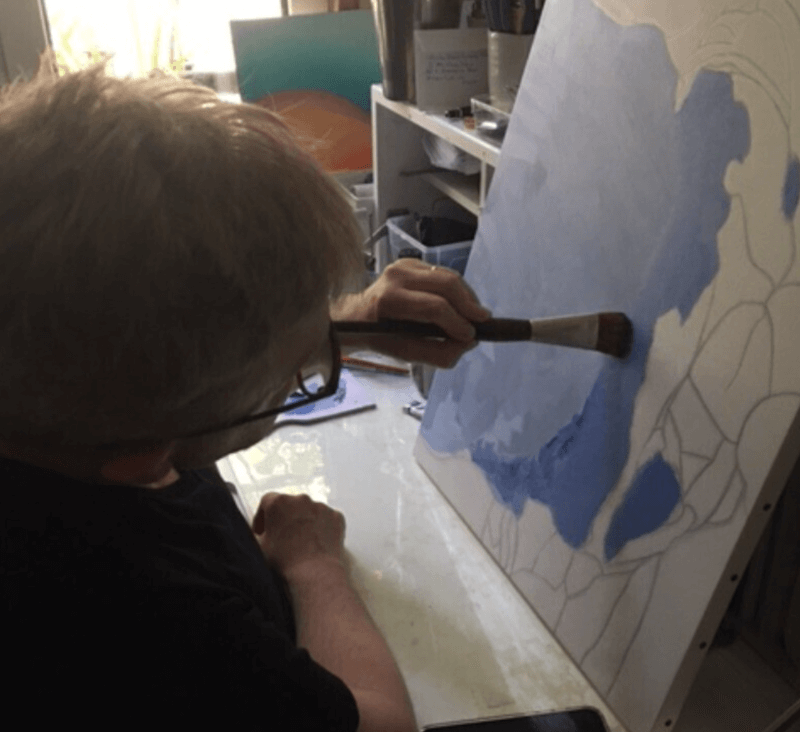
Before beginning the painting, JChadima undertook an extensive photographic study of the Samaritaine, recording the building from multiple sides, angles, and viewpoints. These photographs were not simply preparatory references; they became an essential part of the creative process. By repeatedly examining the structure, its windows, architectural details, surrounding buildings, and changing reflections, the artist assembled a visual archive from which the final composition could evolve.

The painting’s perspective was equally deliberate. JChadima selected and developed a viewpoint that emphasizes the monumentality and importance of the Samaritaine within the surrounding Parisian cityscape. The upward progression of the façade accentuates its scale, while the repeated geometry of the windows creates an architectural rhythm that carries the eye across and through the composition.

Within this structure, however, stability gives way to continual change. Each mirrored pane contains a different fragment—architecture, sky, light, shadow, and surrounding Parisian space. The façade consequently becomes a mosaic of individual observations, in which no single reflection defines the building. The Samaritaine is simultaneously subject, surface, and witness to the city around it.

Of particular significance is the reflected presence of Église Saint-Germain-l'Auxerrois. Its appearance within the glass brings separate periods of Parisian architectural history into direct visual dialogue. One historic structure is contained within the reflection of another, compressing different layers of the city’s past and present onto a single painted surface.

JChadima reinforces this interplay through restrained blues, greys, warmer architectural tones, and areas of shadow. At close range, windows become individual fields of colour and reflection; from farther away, they reassemble into the larger architectural whole. The painting consequently moves between representation and abstraction, permanence and transience, architecture, and memory.

Within the context of Paris, Samaritaine can be understood as more than an architectural portrait. The extensive photographic preparation, carefully constructed perspective, and fragmented reflections preserve the building at a specific moment of transformation while acknowledging the larger city that surrounds it. JChadima creates a portrait not simply of the Samaritaine, but of Paris as a continually evolving accumulation of architecture, history, reflection, and time.

“Every pane tells a different story; together they become a portrait of time.”

Provenance:

CERTIFICATE OF AUTHENTICITY N° 20241009120559 | REFERENCE/ISNI : 2018-04

AKOUN CERTIFIED : 9500 Euros

EXHIBITIONS :

24eme SALON DES PEINTRES DU MARAIS, HALLE DES BANCS MANTEAUX, PARIS
À propos de l’œuvre

SAMARITAINE 

In Samaritaine, JChadima presents one of Paris’s emblematic architectural landmarks not as a fixed monument, but as a living record of time, memory, reflection, and urban transformation. The painting emerged during a period when the historic building remained visibly deteriorated and in transition, allowing the artist to document a moment in its history that would ultimately disappear.

Before beginning the painting, JChadima undertook an extensive photographic study of the Samaritaine, recording the building from multiple sides, angles, and viewpoints. These photographs were not simply preparatory references; they became an essential part of the creative process. By repeatedly examining the structure, its windows, architectural details, surrounding buildings, and changing reflections, the artist assembled a visual archive from which the final composition could evolve.

The painting’s perspective was equally deliberate. JChadima selected and developed a viewpoint that emphasizes the monumentality and importance of the Samaritaine within the surrounding Parisian cityscape. The upward progression of the façade accentuates its scale, while the repeated geometry of the windows creates an architectural rhythm that carries the eye across and through the composition.

Within this structure, however, stability gives way to continual change. Each mirrored pane contains a different fragment—architecture, sky, light, shadow, and surrounding Parisian space. The façade consequently becomes a mosaic of individual observations, in which no single reflection defines the building. The Samaritaine is simultaneously subject, surface, and witness to the city around it.

Of particular significance is the reflected presence of Église Saint-Germain-l'Auxerrois. Its appearance within the glass brings separate periods of Parisian architectural history into direct visual dialogue. One historic structure is contained within the reflection of another, compressing different layers of the city’s past and present onto a single painted surface.

JChadima reinforces this interplay through restrained blues, greys, warmer architectural tones, and areas of shadow. At close range, windows become individual fields of colour and reflection; from farther away, they reassemble into the larger architectural whole. The painting consequently moves between representation and abstraction, permanence and transience, architecture, and memory.

Within the context of Paris, Samaritaine can be understood as more than an architectural portrait. The extensive photographic preparation, carefully constructed perspective, and fragmented reflections preserve the building at a specific moment of transformation while acknowledging the larger city that surrounds it. JChadima creates a portrait not simply of the Samaritaine, but of Paris as a continually evolving accumulation of architecture, history, reflection, and time.

“Every pane tells a different story; together they become a portrait of time.”

Provenance:

CERTIFICATE OF AUTHENTICITY N° 20241009120559 | REFERENCE/ISNI : 2018-04

AKOUN CERTIFIED : 9500 Euros

EXHIBITIONS :

24eme SALON DES PEINTRES DU MARAIS, HALLE DES BANCS MANTEAUX, PARIS

fallback text for a video
A propos de l'artiste Jchadima

JChadima (James Chadima) is a Paris-based multidisciplinary artist whose work has been exhibited and collected internationally.

Born in Wisconsin, United States, JChadima studied at the University of Southern Colorado (USC), now Colorado State University Pueblo, where he earned several degrees. He began exhibiting and selling his work at an early age, establishing the foundations of a multidisciplinary practice in which drawing, painting, and photography would become closely intertwined.

His artistic formation was shaped by an important pedagogical lineage extending into twentieth-century American Modernism and fine-art photography. Particularly influential were his studies with Professor John Henry Johnson, whose guidance helped JChadima cultivate a more discerning way of seeing—one that looked beyond the immediate subject to recognize the expressive potential of light, form, structure, and details that might otherwise escape notice. Johnson’s personal relationships and correspondence with Ansel Adams and others associated with the American Modernist movement provided JChadima with an important connection to an earlier generation. This formative experience situated his developing vision within a broader dialogue with American Modernist figures such as Alfred Stieglitz, Georgia O’Keeffe, Arthur Dove, and Adams, whose work demonstrated how close observation and individual perception could transform familiar subjects into powerful vehicles for abstraction and expression.

Photography is both the initial stage and an integral component of JChadima’s creative process, functioning as an independent medium as well as a means of visual discovery. His subjects are drawn from nature, still life, urban and environmental surroundings, and the broader cultural landscape of contemporary life. Through the camera, he isolates relationships of light, line, form, colour, pattern, and texture, revealing visual structures that can easily pass unnoticed. These photographic impressions often provide the initial impetus for his paintings, in which recognizable imagery is distilled, reorganized, and transformed through abstraction. The resulting compositions are highly stylized and graphic, distinguished by structural clarity, rhythmic relationships, and a vibrant use of colour.

Central to JChadima’s philosophy is a belief in a “hidden magic” within our surroundings and ourselves. His focus on modest, familiar, and frequently overlooked subjects reflects a desire to recover a sense of wonder increasingly obscured by the visual noise, accelerated pace, and environmental pressures of contemporary life.
The ordinary is not simply recorded; it becomes material for reconsideration and transformation.

A tree, leaf, flower, architectural detail, or fragment of landscape becomes more than a recognizable subject. Through isolation and abstraction, a single detail can reshape our perception of the whole, while forms drawn from nature evoke both their inherent beauty and fragility in the face of growing environmental pressures.

Ultimately, JChadima’s art invites us to pause and look again, revealing the extraordinary within the seemingly ordinary while renewing our awareness of nature and our relationship with it.

Recognized by AKOUN, an international art-market reference, JChadima holds an established international quotation for his work.

RECENT PUBLICATIONS:
https://louvreunbound.aflip.in/2a9d2d8df5.html#page/38