
THE COLORADO RIVER
THE COLORADO RIVER
États-Unis d’Amériques
JChadimaPainting
Style : Abstract
Oil, Linen canvas, 2022
80 cm x 40 cm
Couldn't load pickup availability
Shipping & Returns
Shipping & Returns
- Professional worldwide delivery, monitored by our logistics experts
- Shipping, taxes, and customs duties are included in the price
Warranty
Warranty
Horizon World Art guarantees reliability and traceability.
All artists on the platform have been specially selected and certify that they only sell works of which they are the authors. Regardless of the medium, the work is sent to the buyer with a certificate of authenticity. Photographs are numbered and signed.
Each customer can receive a copy of their certificate of authenticity by contacting contact@horizonworldart.com
Payment
Payment
With Horizon World Art, you can pay securely by credit card or bank transfer.
For all transactions exceeding your credit limit, please contact us. We are required to verify each transfer as part of our efforts to combat fraud and money laundering.
Price
Price
Horizon World Art prices include the following:
- Artwork price as set by an artist
- Insurance. Your order is 100% protected against damage or loss
- Customs duties, taxes and document preparation
- Shipping costs from the logistics provider
- An Horizon World Art customer service specialist who will answer all your questions or concerns during shipping
About the artwork
About the artwork
THE COLORADO RIVER
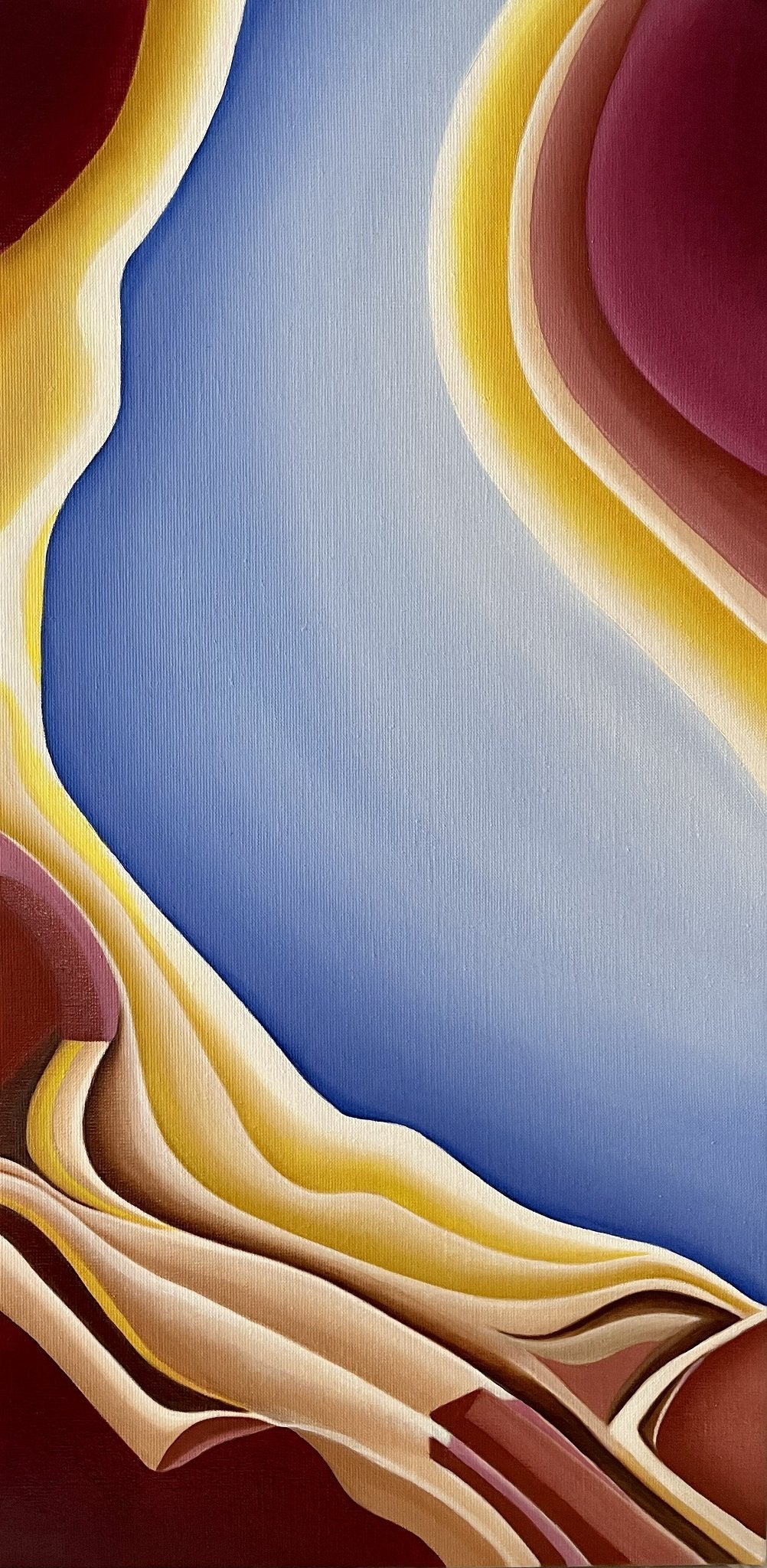
In The Colorado River, JChadima approaches the landscape not as a conventional panoramic view, but as an abstracted experience of water, canyon, light, and geological form. The elongated vertical format compresses the landscape into a powerful upward movement. A broad field of atmospheric blue occupies the core, while layered bands of ochre, cream, burgundy, and earthen red press inward from the edges, suggesting canyon walls shaped and exposed by the persistent movement of water.
The painting belongs to a long history of artists interpreting the Colorado River and the American West. Rather than depicting a recognizable vista, JChadima distils the experience of the river and canyon into colour, contour, rhythm, and spatial relationships.
In this respect, The Colorado River enters into a distinctly modernist conversation. Georgia O’Keeffe similarly responded to the Colorado River and canyon country by simplifying observed landscape into concentrated arrangements of line and form. JChadima’s painting shares this principle of transformation while establishing its own vocabulary of sweeping, layered forms and controlled colour.
The central blue passage can be read simultaneously as river, atmosphere, distance, and negative space. Around it, the undulating strata suggest the accumulated geological layers of the Arizona landscape. These flowing forms evoke the immense passage of geological time and the continual action of water upon stone.
Underlying the composition is JChadima’s conservationist concern for the growing vulnerability of the American West’s waterways. Climate change, prolonged drought, and increasing demands on limited water resources give the painting a contemporary urgency. The Colorado River becomes both landscape and symbol—a reminder of the fragile balance between the natural environment and the human communities that depend upon it.
The painting originated from photographic studies of the Colorado River at Horseshoe Bend, Arizona. From these studies, the identifying details of the location were progressively stripped away, leaving the essential relationships of river, canyon, geological strata, and space. Through this process of reduction and abstraction, Horseshoe Bend is transformed from a specific place into a more universal expression of water, landscape, time, and environmental vulnerability.
Provenance:
CERTIFIED EXPERT N° 20260905023600 | REFERENCE/ISNI: 2022-21
AKOUN CERTIFIED: 2750 Euros.
Exhibitions:
HP8A -ESPACE BEAUJON FAUBOURG SAINT HONORE, PARIS
Jchadima
-
DEVIL'S SNARE 1
Artist:JchadimaRegular price €625,00 EURRegular priceUnit price per -
DEVIL'S SNARE 2
Artist:JchadimaRegular price €625,00 EURRegular priceUnit price per -
CLEMENTINE STUDY
Artist:JchadimaRegular price €850,00 EURRegular priceUnit price per


